I was out in the Atlantic yesterday on a cruise from Portsmouth to the Isles of Shoals. They are nine islands six miles off the coast, half in NH and half in ME. People used to live out here year round beginning in the early 17th century; they were cod fishermen, for the most part. There’s a big hotel on Star Island (the Oceanic Hotel), which was a popular resort in the latter half of the 19th century and is still used today. Shoals Marine Laboratory on Appledore Island is operated by my alma mater, the University of New Hampshire. What an awesome place for a hands-on classroom!
Author: Peter Mires
Peter Mires is a writer living in Reno, Nevada.
The History Press will publish my next book in 2018.
 I just signed a book deal with The History Press. The book’s title is Lost Carson City, and it will be included in their Lost series. Click on the link above to see other books in this series. You’ll notice they mostly pertain to forgotten aspects of various American cities. Stay tuned for further developments.
Spring/Summer 2017 Talks

Here’s where I’m speaking this Spring and Summer:
- March 27: History of Architecture Class, University of Nevada, Reno.
- May 6: South Lake Tahoe Public Library.
- June 1: South Reno Rotary Club, Atlantis Casino, Reno.
- June 14: Nevada Historical Society, Reno.
- June 15: Nevada County Historical Society, Nevada City, CA.
- June 23: Tahoe Douglas Rotary Club, Montbleu Resort, Stateline, NV.
- August 23: Tahoe Douglas Seniors, Harrah’s Lake Tahoe Hotel & Casino, Stateline, NV.
A Nice Review in the Tahoe Quarterly
The Tahoe Quarterly 2017 Mountain Home Awards issue gives my book, Lake Tahoe’s Rustic Architecture, a nice shout-out (see p. 66). Thanks TQ!

Upcoming Article in the Mark Twain Journal
 I have an article in the next issue of the Mark Twain Journal (Vol. 55, Spring 2017) titled “Mark Twain on Architecture.” Here’s the journal’s publicity blurb:
“Historical geographer Peter B. Mires takes note of Twain’s use of architectural imagery throughout his body of work and argues that Twain not only understood architecture well but that he masterfully employed architectural descriptions as a literary device over the course of his career. Sandra Hedicke Clark contributes original pen and ink illustrations to this essay.”
Snow in the Sierra
 I went over Donner Summit this past Sunday, January 15, 2017, and stopped at the rest area, which, as you can see, was buried in snow. Just for scale, I’m six foot one. We’ve been having a great winter, thanks to the meteorological phenomenon they’re calling the “atmospheric river.” It’s a real drought buster and long overdue. I couldn’t help reflecting on the poor Donner Party who were stuck up here the winter of 1846-47. Double the amount of snow, add starvation, and you get a sense of their ordeal. Lucky me; immediately after this photo was taken I got in my car, zipped down Interstate 80, and before long found myself having lunch at a cozy restaurant in California’s Gold Country. I did remember to say a silent Grace, thankful for many blessings.
Autumn in Quebec

I’m visiting our neighbor to the north for several days, and though the title of this post is Autumn in Quebec, which it is according to our astronomical calendar, that’s a little deceiving; the fall colors are not yet much in evidence. Ordinarily, up here the last week of September and the first week of October constitute peak foliage season. It’s beautiful nonetheless.
I came to Quebec to see my nephew Stephen receive his doctorate (on Sept. 24) from the University of Sherbrooke, located in a nice French Canadian city about an hour east of Montreal.
 I’m a sucker for all that pomp and circumstance stuff, although that academic anthem–a sine qua non of American colleges and universities–was not heard. All the regalia, ceremony, and happy faces full of accomplishment and hope for the future is always an inspiration.

Spent today with my sisters and nephew just driving around the Lake Memphremagog region, which is centered on a glacially carved lake that spans the distance between Newport, Vermont and Magog, Quebec (most of it being on the Canadian side of the border). We visited the beautiful Saint Benedict Abbey, famous for its cheese and apples available in the gift shop, and, of course, for the Abbey itself.
Quarry Farm Research Fellowship
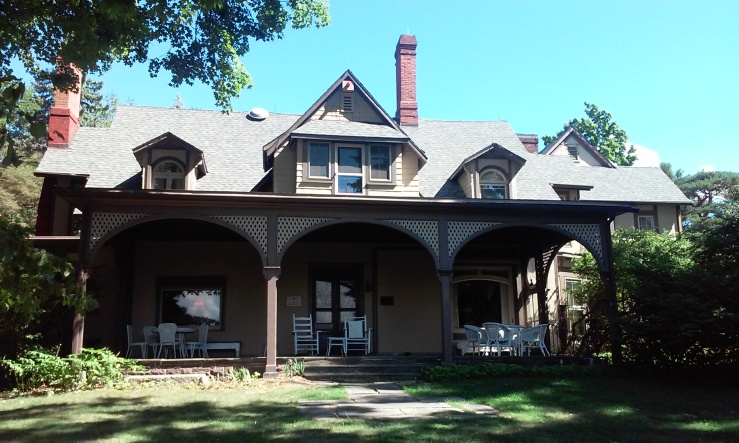 I think I’ve died and gone to heaven. I have a residency at the Elmira College Center for Mark Twain Studies, Sept. 1-15, 2016, and I’m staying at Quarry Farm. Elmira, New York is where Olivia Langdon, who became Mrs. Samuel Clemens (Mark Twain) on February 2, 1870, grew up, and Quarry Farm is where the Twain family spent summers throughout the 1870s and 1880s, Mark Twain’s most productive years as a writer.
 This is a photo of Mark Twain in 1903 sitting inside the octagonal study Olivia’s sister and brother-in-law built for him in 1874. It was situated on a knoll a short distance from the main house, and Twain loved this special writing space. The Twain study was subsequently (1952) moved to the Elmira College campus. It’s probably every writer’s dream to have a sanctuary like this where words can flow. And flow they did for Twain…old school, pen and paper!
My project while I’m here is “Mark Twain on Architecture.” Consider this passage from Life on the Mississippi where he ruminates on the Old Louisiana State Capitol on the east bank of the Mississippi River in Baton Rouge:
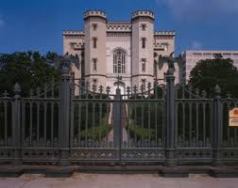
Sir Walter Scott is probably responsible for the Capitol building; for it is not conceivable that this little sham castle would ever have been built if he had not run the people mad, a couple of generations ago, with his medieval romances….It is pathetic enough that a whitewashed castle with turrets and things…should ever have been built in this otherwise honorable place; but it is much more pathetic to see this architectural falsehood undergoing restoration and perpetuation in our day, when it would have been so easy to let dynamite finish what a charitable fire began, and then devote this restoration money to the building of something genuine.
Mark Twain clearly felt this Gothic Revival “architectural falsehood” was inconsistent with the cultural landscape of the lower Mississippi Valley, and said so in his wonderfully unique prosaic style. In terms of architectural criticism, I think of Mark Twain as the Tom Wolfe (From Bauhaus to Our House) of the Gilded Age. In fact, it should come as no surprise that someone as perceptive as Mark Twain would notice and comment on architecture insofar as the latter half of the nineteenth century was characterized by incredible diversity in building types and styles. Interesting stuff indeed!

It’s such a privilege to spend two weeks with Twain. Although I’m at Quarry Farm most of the time, I do pay my respects at Woodlawn Cemetery to the man who came in and went out with Halley’s Comet.
Hiking the Tahoe Rim Trail
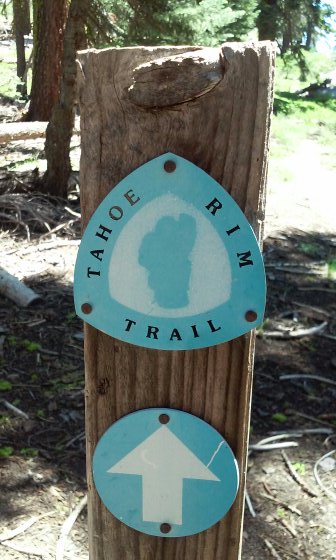
This summer I’m hiking the Tahoe Rim Trail (TRT). The TRT circumscribes the mountainous perimeter of the Lake Tahoe Basin. It’s pretty high up too; most of the trail is between 7,000 and 10,000 feet above sea level. You can read about this bucket-list adventure in an article I wrote for Nevada Magazine.
The Rustic Road Show
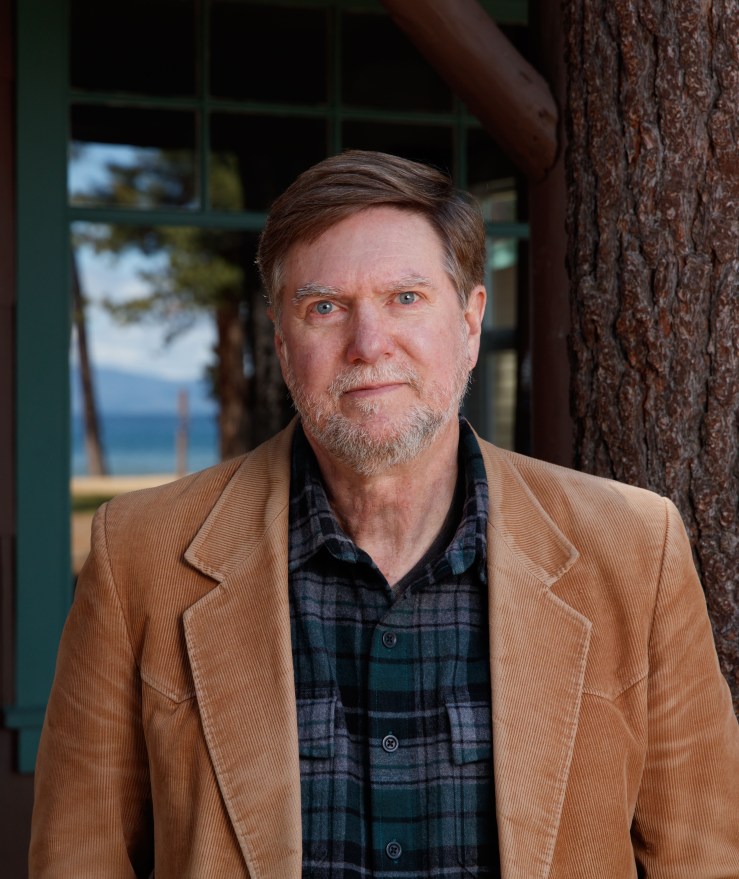
With my book Lake Tahoe’s Rustic Architecture coming out this summer (July 18, 2016), I’m beginning to line up a few appearances. Here’s the schedule so far:
- July 30 (noon-2:00 pm). St. Peter’s Episcopal Church, Carson City, NV.
- Aug. 6 (noon-2:00 pm). Morley’s Books, Carson City, NV.
- Aug. 13 (noon-1:00 pm). North Lake Tahoe Historical Society, Tahoe City, CA.
- Aug. 18 (7:00-8:00 pm). Nevada County Historical Society, Nevada City, CA.
- Aug. 20 (1:00-3:00 pm). Barnes & Noble, Reno, NV.
- Oct. 15 (10:00-11:30 am). South Lake Tahoe Library, South Lake Tahoe, CA
 Peter Mires